xDX Application Profile
Purpose
The purpose of this application profile is to document how xDX Project data is modelled for compatibility with the wider LINCS data model. This document provides patterns used in the mapping of xDX data which correspond to the categories of the main LINCS Application Profiles.
This document introduces classes and properties as used in this specific context (LINCS and the xDX dataset), without providing complete definitions for them. You can find the full definitions in the documentation of CIDOC CRM version 7.3.1 and other reference ontologies.
Dependencies
This section reports the ontologies, vocabularies, and authority files adopted in the xDX application profile. The tables below list the acronyms used to refer to each resource and the prefixes used to compose the URIs in Turtle code examples found in the document.
Ontologies
For more information about ontologies, see Linked Open Data Basics – Ontologies.
| Acronym | Prefix | Ontology | Purpose |
| CIDOC-CRM | crm: | CIDOC Conceptual Reference Model | Main reference ontology |
| CRMdig | crmdig: | CRM Digital | To represent digital objects |
Vocabularies
For more information about vocabularies, see Linked Open Data Basics – Vocabularies.
| Acronym | Prefix | Vocabulary | Purpose |
| AAT | aat: | Getty AAT | To represent xDX object types, note types, material types, technique types, and dimension types. |
| Biography | biography: | LINCS Biography | To represent name types. |
| Lexvo | lexvo: | Lexvo | To represent languages. |
| Nomenclature | nomenclature: | Nomenclature | To represent some xDX object types. |
| XSD | xsd: | XML Schema Datatypes | For literal datatypes. |
Authority Files
For more information about authority files, see Terms – Authority File.
| Acronym | Prefix | Authority File | Purpose |
| GeoNames | geonames: | GeoNames | For place URIs. |
| LINCS | lincs: | LINCS-minted entities | To represent any entities not described elsewhere. |
| LOC Authorities | loc: | Library of Congress Authorities | For people and group URIs. |
| LOC Relators | relator: | Library of Congress Relators | For actor role URIs. |
| ULAN | ulan: | Getty Union List of Artist Names | For people and group URIs. |
| VIAF | viaf: | Virtual International Authority File | For people and group URIs. |
| Wikidata | wikidata: | Wikidata Knowledge Base | For people and group URIs. |
Main Classes
The classes listed below are imported from CIDOC CRM and use prefix crm: except where otherwise noted.
| Entity Type | Class | Declaration Snippet (Turtle Syntax) |
| xDX Object | E22 Human-Made Object | |
| Owner | E39 Actor | |
| Manufacturer | E74 Group | |
| Production | E12 Production | |
| Acquisition | E8 Acquisition | |
| Material | E57 Material | |
| Dimension | E54 Dimension | |
| Design | E29_Design_or_Procedure | |
| Creation | E65 Creation | |
| IP Right | E30 Right | |
| Place | E53 Place | |
| Designer | E21 Person | |
| Design Firm | E74 Group | |
| Model | E99 Product Type | |
| Series | E99 Product Type | |
| Brand | E99 Product Type | |
| Classification | E99 Product Type | |
| Archival File | E73 Information Object | |
| Name or Title | E33_E41 Linguistic Appellation | |
| Identifier | E42 Identifier | |
| Note | E33 Linguistic Object | |
| Actor in a Role | PC14 Actor in a Role | |
| Webpage | D1 Digital Object (CRMdig) | |
Overview
The xDX dataset reconstitutes the former Design Exchange (DX) collection as a research and educational tool for the study of Canadian design history. The dataset describes the artefacts and archives of the DX collection, along with their designers, manufacturers, and current institutional locations.
The image below shows an overview of the entire xDX application profile. Each section of the diagram is described in detail in one of the sections of this document. Click here or on the image for a large-scale, more readable version.
.svg)
Graph Patterns
This section presents the graph patterns adopted in the xDX application profile, along with examples of usage. The URI of the xDX graph which can be used to query the dataset through the SPARQL endpoint is <http://graph.lincsproject.ca/xdx>.
Basic Patterns
This section describes basic patterns that are reused across the xDX dataset.
Type
| Diagram | .svg) | |
|---|---|---|
| Pattern | Definition | An entity has a type. |
| Abstraction | E1 CRM Entity →P2 has type →E55 Type | |
| Applies to |
| |
| Values | Type of Value | Uniform Resource Identifier (URI). |
| Expected Value | URI from vocabulary or minted by LINCS. | |
| Authorities |
| |
| Examples | Typical Example | The xDX object with ID 2018.308.10.2 a-b (a pepper shaker) has type aat:300043086 (pepper shakers). |
| Example Abstraction | lincs:fsbLT7LgDsY →P2 has type →aat:300043086 | |
| Generalized Pattern (Turtle) | | |
| Sample Data (Turtle) | | |
| Note | Class E1 CRM Entity represents all entities, but is not actually found in the dataset.
More specific classes are applied instead (see Main Classes above). | |
Identifier
| Diagram | .svg) | |
|---|---|---|
| Pattern | Definition | An entity is identified by an ID. |
| Abstraction | E1 CRM Entity →P1 is identified by →E42 Identifier →P190 has symbolic content →xsd:string | |
| Applies to |
| |
| Values | Type of Value | xsd:string (a string of text). |
| Expected Value | An string of text that uniquely identifies the entity. | |
| Authorities |
| |
| Examples | Typical Example | The xDX object Talking table has xDX ID 2024.YU.xDX.00065 and accession ID 997.16. |
| Example Abstraction | lincs:FJex0V2TtPn →P1 is identified by →lincs:SsyJw5WQspO→P190 has symbolic content →"2024.YU.xDX.00065"^^xsd:string | |
| Generalized Pattern (Turtle) | | |
| Sample Data (Turtle) | | |
| Note | Class E1 CRM Entity represents all entities, but is not actually found in the dataset.
More specific classes are applied instead (see Main Classes above). | |
Name & Title
| Diagram | .svg) | |
|---|---|---|
| Pattern | Definition | An entity is identified by an appellation (name or title). |
| Abstraction | E1 CRM Entity →P1 is identified by →E33 E41 Linguistic Appellation →P190 has symbolic content → xsd:string | |
| Applies to |
| |
| Values | Type of Value | xsd:string (a string of text). |
| Expected Value | A string of text that identifies the entity. | |
| Authorities |
| |
| Examples | Typical Example | The object with xDX ID 2024.YU.xDX.00063 is named Roo Chair (in English). |
| Example Abstraction | lincs:mIUZ7wQga5W →P1 is identified by →lincs:vCCq8FrWiAj →P190 has symbolic content → "Roo Chair"@en | |
| Generalized Pattern (Turtle) | | |
| Sample Data (Turtle) | | |
| Note | Class E1 CRM Entity represents all entities, but is not actually found in the dataset.
More specific classes are applied instead (see Main Classes above). | |
Location
| Diagram | .svg) | ||
|---|---|---|---|
| Pattern | Definition | An event happens at a location. | |
| Abstraction | E1 CRM Entity →P7 took place at →E53 Place | ||
| Applies to | Production and Creation. Every production or creation happens at exactly one location. | ||
| Values | Type of Value | A URI uniquely identifying the location (Place). | |
| Expected Value | Uniform Resource Identifier (URI). | ||
| Authorities | GeoNames for the place URI. | ||
| Examples | Typical Example | The production of Swivel Chair took place in Toronto, Canada. | |
| Example Abstraction | E12 Production →P7 took place at →E53 Place | ||
| Generalized Pattern (Turtle) | | ||
| Sample Data (Turtle) | | ||
Date
| Diagram | .svg) | ||
|---|---|---|---|
| Pattern | Definition | An event happens on a certain date (or date range). | |
| Abstraction | E1 CRM Entity →P4 has time-span →E52 Time-Span →P82 at some point within → xsd:string
P82a begin of the begin → xsd:dateTime
P82b end of the end → xsd:dateTime | ||
| Applies to | Production and Creation. Every production or creation happens on a certain date (or date range). | ||
| Values | Type of Value | xsd:string for the human-readable date.
xsd:dateTime for the date's begin of begin.
xsd:dateTime for the date's end of end. | |
| Expected Value | A string of text expressing the date (or date range) of the event. A datetime value expressing the earliest possible beginning time. A datetime value expressing the latest possible end time. | ||
| Authorities | XSD for the datatypes of date values. | ||
| Examples | Typical Example | The production of Swivel Chair took place in 1967. | |
| Example Abstraction | E12 Production →P4 has time-span →E52 Time-Span →P82 at some point within → xsd:string
P82a begin of the begin → xsd:dateTime
P82b end of the end → xsd:dateTime | ||
| Generalized Pattern (Turtle) | | ||
| Sample Data (Turtle) | | ||
Actor in a Role
| Diagram | .svg) | |
|---|---|---|
| Pattern | Definition | An activity may have a number of participants, each with a certain role. |
| Abstraction | E7 Activity →P01i is domain of →PC14 Carried Out By →P02 has range →E39 ActorPC14 Carried Out By →P14.1 in the role of →E55 Type | |
| Applies to | Production and Creation. Every production or creation may have one or more participants, each with a certain role. | |
| Values | Type of Value | Uniform Resource Identifier (URI) |
| Expected Value | URI from authority file or minted by LINCS (activity). URI from authority file or minted by LINCS (actor). URI from vocabulary or minted by LINCS (role). URI minted by LINCS (actor with role). | |
| Authorities | LINCS for the URI of the activity.
Virtual International Authority File, Wikidata, ULAN, or LINCS for the URI of the actor. Wikidata for the URI of the role. LINCS for the URI of the actor-with-role (representing the participation of the actor in the activity). | |
| Example Values | lincs:q8y0X1gQaYp (Production of radio)
lincs:Fd7lG4o4G8I (Addison Industries)
lincs:jgjSicpGkf6 (Addison Industries in the role of manufacturer producing radio)
relator:mfr (manufacturer) | |
| Examples | Typical Example | Addison Industries produced the radio with xDX ID 2018.308.81 in the role of manufacturer. |
| Example Abstraction | lincs:WnPIpSjU1Qd →P01i is domain of →lincs:jgjSicpGkf6 →P02 has range →lincs:Fd7lG4o4G8Ilincs:jgjSicpGkf6 →P14.1 in the role of →relator:mfr | |
| Generalized Pattern (Turtle) | | |
| Sample Data (Turtle) | | |
xDX Object
An xDX object is typically a mass-produced object designed by one or more designers and produced by one or more manufacturers. The dataset represents basic information about the object, including its material(s), dimensions, work type, general classification, and acquisition history. The dataset also describes the object's model, series, and brand.
xDX objects were originally part of the Design Exchange (DX) collection and are now held at the Royal Ontario Museum, the Canadian Museum of History, Carleton University, and York University.
Production
xDX objects were produced between 1940 and 2010 by Canadian and international manufacturers.
| Diagram | .svg) | |
|---|---|---|
| Pattern | Definition | A production has a number of participants, each with a certain role. |
| Abstraction | E22 Human-Made Object →P108i_was_produced_by →E12 Production | |
| Applies to | xDX Object. Every object has exactly one production event. | |
| Values | Type of Value | Uniform Resource Identifier (URI). |
| Expected Value | A URI that identifies the production event. | |
| Authorities | LINCS for the URI of the production event. | |
| Example Values | lincs:Ir9lGGfxoa1 (Production of Swivel Chair) | |
| Examples | Typical Example | The xDX object lincs:sqCTaiRS8dr (Swivel Chair) was produced by production event lincs:Ir9lGGfxoa1 |
| Example Abstraction | lincs:sqCTaiRS8dr →P108i_was_produced_by →lincs:Ir9lGGfxoa1 | |
| Generalized Pattern (Turtle) | | |
| Sample Data (Turtle) | | |
Design
xDX objects were designed by designers who could be employed by firms or work independently. For the modelling of individual designers, see the Designer section below. For the modelling of firms, see the Design Firm section.
| Diagram | .svg) | |
|---|---|---|
| Pattern | Definition | A design is about an object. |
| Abstraction | E29 Design or Procedure →P129 is about →E22 Human-Made Object | |
| Applies to | xDX Object. Every object has exactly one design. | |
| Values | Type of Value | Uniform Resource Identifier (URI) |
| Expected Value | A URI that identifies the design. | |
| Authorities | LINCS for the URI of the design. | |
| Example Values |
| |
| Examples | Typical Example | The design of Umbra Ah chair is about xDX object Umbra Ah chair. |
| Example Abstraction | lincs:N98E5UQvFjP →P129 is about →lincs:1layHqywOXM | |
| Generalized Pattern (Turtle) | | |
| Sample Data (Turtle) | | |
Acquisition
xDX objects may have a record of how they were originally acquired by the Design Exchange (DX) from one or more owners (people or groups) before their transfer from the DX to their current holding institution (Owner). For the modelling of individual owners, see the Owner section below.
| Diagram | .svg) | |
|---|---|---|
| Note | The modelling of object acquisitions is described in detail in the Acquisition section below. | |
Material
| Diagram | .svg) | |
|---|---|---|
| Pattern | Definition | An object is made of a certain material. |
| Abstraction | E22 Human-Made Object →P45 consists of →E57 Material | |
| Applies to | xDX Object. Every object consists of one or more materials. | |
| Values | Type of Value | Uniform Resource Identifier (URI) |
| Expected Value | A URI that identifies the material. | |
| Authorities | AAT or LINCS for the URI of the material. | |
| Example Values | aat:300010900 (metal) | |
| Examples | Typical Example | The MS-SC Stacking Chair (lincs:gxCvyeH3NUZ) is made of metal (aat:300010900). |
| Example Abstraction | lincs:gxCvyeH3NUZ →P45 consists of →aat:300010900 | |
| Generalized Pattern (Turtle) | | |
| Sample Data (Turtle) | | |
Dimension
| Diagram | .svg) | |
|---|---|---|
| Pattern | Definition | An object has certain dimensions. |
| Abstraction | E22 Human-Made Object →P43 has dimension →E54 Dimension →P2 has type → E55 TypeP91 has unit → E55 TypeP90 has value → xsd:decimal | |
| Applies to | xDX Object. Each object may have one or more recorded dimensions. | |
| Values | Type of Value | Uniform Resource Identifier (URI) for the dimension, type, and unit. Literal for the dimension value. |
| Expected Value | A URI that identifies the dimension. A URI that identifies the dimension type. A URI that identifies the dimension unit. A literal that expresses the dimension value. | |
| Authorities | LINCS for the URI of the dimension. LINCS for the dimension type. AAT for the dimension unit. XSD for the dimension value. | |
| Example Values | lincs:fscVw9ZHexL (dimension).aat:300072633 (dimension type).aat:300379098 (dimension unit).50.4 (dimension value). | |
| Examples | Typical Example | The Roo Stacking Chair has a recorded width of 52.1 cm and a recorded depth of 50.4 cm. |
| Example Abstraction | lincs:3pfsCrz1HJM →P43 has dimension →lincs:fscVw9ZHexL →P2 has type → aat:300072633P91 has unit → aat:300379098P90 has value → 50.4 | |
| Generalized Pattern (Turtle) | | |
| Sample Data (Turtle) | | |
Identifier
Each object has exactly one xDX identifier and one accession identifier.
| Diagram | .svg) |
|---|---|
| Note | The modelling of xDX object identifiers follows the basic pattern for Identifiers. See the corresponding section for more information. |
Name
Each object has exactly one preferred name and may have one or more alternative names.
| Diagram | .svg) |
|---|---|
| Note | The modelling of xDX object names follows the basic pattern for Names & Titles. See the corresponding section for more information. |
Work Type
Each object has a specific work type, such as chair or kettle.
| Diagram | .svg) | |
|---|---|---|
| Note | The modelling of object classifications follows the basic pattern for Types. See also the Conceptual Layer section for more information. | |
Classification
Each object may have a general classification, such as furniture.
| Diagram | .svg) | |
|---|---|---|
| Note | The modelling of object classifications follows the basic pattern for Types. See also the Conceptual Layer section for more information. | |
Model
Each object may have a specific model, such as K800 or MS-SC Stacking Chair.
| Diagram | .svg) | |
|---|---|---|
| Note | The modelling of xDX object models follows the basic pattern for Types. See also the Conceptual Layer section for more information. | |
Series
Each object may have a specific series, intended as a grouping of models, such as Clairtone G Series.
| Diagram | .svg) | |
|---|---|---|
| Note | The modelling of xDX object models follows the basic pattern for Types. See also the Conceptual Layer section for more information. | |
Brand
Each object may have a specific brand, such as General Electric.
| Diagram | .svg) | |
|---|---|---|
| Note | The modelling of xDX object brands follows the basic pattern for Types. See the Conceptual Layer section section for more information. | |
Prototype
An object may be assigned a special type to indicate that it is a prototype. A prototype is a unique object that is made during the design phase before the final model goes into production.
| Diagram | .svg) | |
|---|---|---|
| Note | The modelling of prototypes follows the basic pattern for Types. See the corresponding section for more information. | |
Object Set
Each object may part of an object set. A set is always composed of multiple objects, while each object may be part of at most one set.
| Diagram | .svg) | |
|---|---|---|
| Pattern | Definition | An object may be part of an object set. |
| Abstraction | E22 Human-Made Object →P46i forms part of →E22 Human-Made Object | |
| Applies to | xDX Object. Each object may be part of at most one set. | |
| Values | Type of Value | Uniform Resource Identifier (URI). |
| Expected Value | A URI that uniquely identifies the object set. | |
| Authorities | LINCS for the URI of the object set. | |
| Example Value | lincs:H6cDWhEk8fy (Habitat Chair and Ottoman). | |
| Examples | Typical Example | The objects Habitat Chair and Habitat Ottoman are part of the object set Habitat Chair and Ottoman. |
| Example Abstraction | lincs:9T8z3PV92h2 →P46i forms part of →lincs:H6cDWhEk8fylincs:zpTUVGQhd9K →P46i forms part of →lincs:H6cDWhEk8fy | |
| Generalized Pattern (Turtle) | | |
| Sample Data (Turtle) | | |
Image
An object may have one or more images associated with it.
| Diagram | .svg) | |
|---|---|---|
| Pattern | Definition | An object is represented by an image. |
| Abstraction | E22 Human-Made Object (CRMdig)→ P138i has representation→ E36 Visual Item | |
| Values | Type of Value | Uniform Resource Identifier (URI). |
| Expected Value | A URI representing an image. | |
| Authorities | LINCS for the URI of the image. | |
| Example Value | 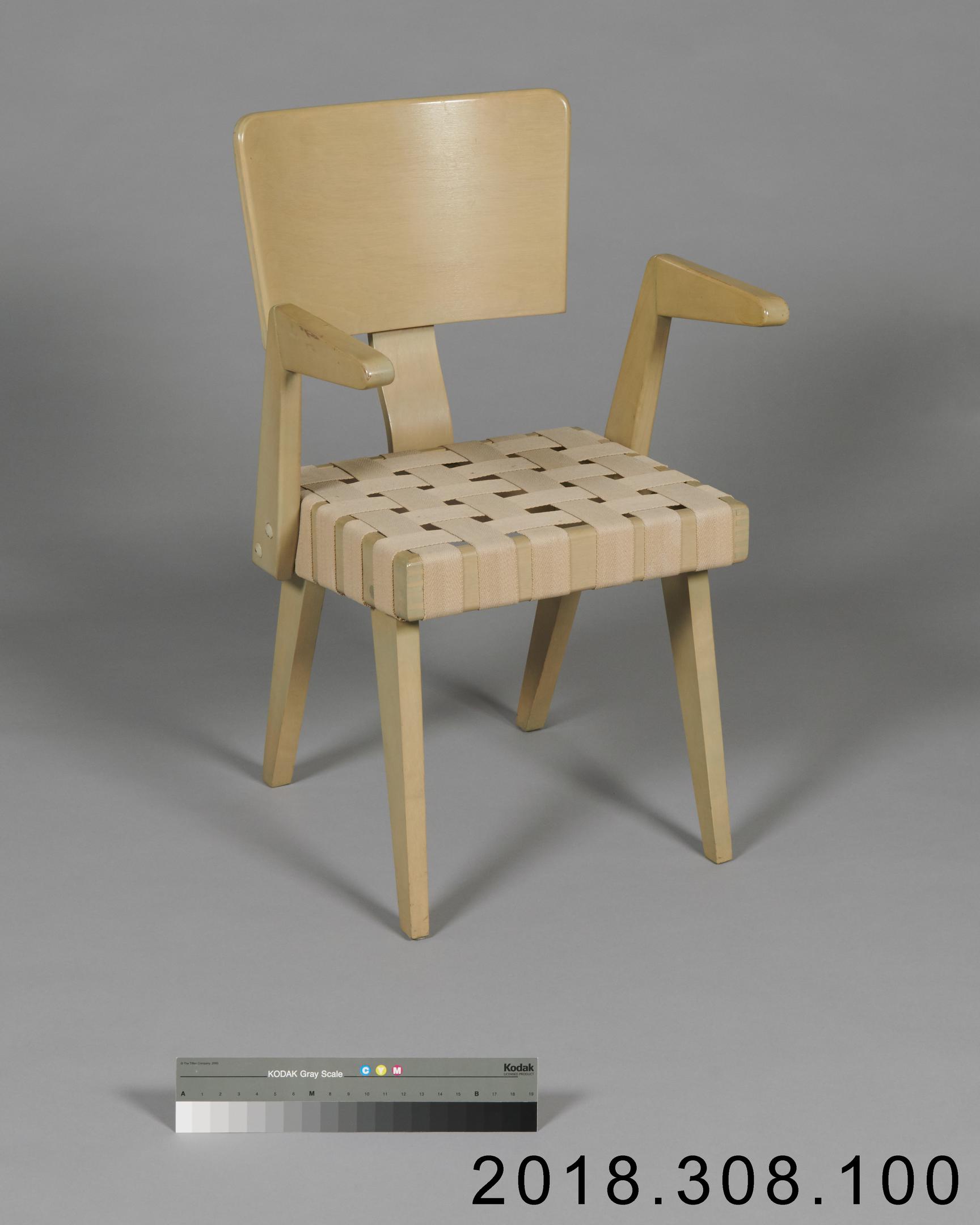 | |
| Examples | Typical Example | The armchair with xDX ID 2018.308.100 is represented by the image with URI https://www.historymuseum.ca/ke/_resources/5740244/IMG2021-0040-0007-Dm-cmhsize-large.jpg. |
| Example Abstraction | <https://collections.ssac.carleton.ca/index.php/Detail/objects/2870>→ P138i has representation→ | |
Production
A production is an event through which an xDX object was produced. The dataset represents basic information about production, including manufacturer, production technique(s), date, and location. Each xDX object has exactly one production event, but a production event may have produced multiple xDX objects.
Manufacturer
| Diagram | .svg) | |
|---|---|---|
| Note | The modelling of manufacturers follows the basic pattern for Actors in a Role. See the corresponding section for more information. | |
Material
| Note | The production of an xDX object employs one or more materials. In this dataset, materials are not connected to the production event, but rather to the object. See Material above. |
|---|
Technique
| Diagram | .svg) | |
|---|---|---|
| Pattern | Definition | A production may employ a technique. |
| Abstraction | E12 Production →P32 used general technique →E55 Type | |
| Applies to | Production. Each production may employ one or more techniques. | |
| Values | Type of Value | Uniform Resource Identifier (URI). |
| Expected Value | A URI that uniquely identifies the technique. | |
| Authorities | AAT or LINCS for the URI of the technique. | |
| Example Value | aat:300053796 (lacquering). | |
| Examples | Typical Example | The production of the object lincs:e9kWn3HCBid (a lampshade) used technique aat:300053796 (lacquering). |
| Example Abstraction | lincs:7nrBI4uPI35 →P32 used general technique →aat:300053796 | |
| Generalized Pattern (Turtle) | | |
| Sample Data (Turtle) | | |
Design
| Diagram | .svg) | |
|---|---|---|
| Pattern | Definition | A production may employ a specific design. |
| Abstraction | E12 Production →P33 used specific technique →E29 Design or Procedure | |
| Applies to | Production. Each production employs exactly one design. | |
| Values | Type of Value | Uniform Resource Identifier (URI). |
| Expected Value | A URI that uniquely identifies the design. | |
| Authorities | LINCS for the URI of the design. | |
| Example Value | lincs:Yk9iIPjWkl0 (design of Boogie Board) | |
| Examples | Typical Example | The production of object lincs:PSDYebfv62t (Boogie Board) employed design lincs:Yk9iIPjWkl0 (Design of Boogie Board). |
| Example Abstraction | lincs:3E8IRe4weIu →P33 used specific technique →lincs:Yk9iIPjWkl0 | |
| Generalized Pattern (Turtle) | | |
| Sample Data (Turtle) | | |
Location
| Diagram | .svg) |
|---|---|
| Note | The modelling of production locations follows the basic pattern for Locations. See the corresponding section for more information. |
Date
| Diagram | .svg) |
|---|---|
| Note | The modelling of production dates follows the basic pattern for Dates. See the corresponding section for more information. |
Type
| Diagram | .svg) |
|---|---|
| Note | The production type follows the basic pattern for Types. See the corresponding section for more information. |
Design
A design is the chosen plan for the production of a specific model or object. The dataset represents basic information about the design of models and objects, including the designer, date, and location. Each xDX object has exactly one design, but a single design could be employed for the production of multiple xDX objects of the same model. However, in the case of prototypes, a design may have led to the production of a single object, as prototypes are usually not mass-produced.
Creation
A design is created by a designer at a certain date and location. The designer may or may not belong to a design firm.
| Diagram | .svg) | |
|---|---|---|
| Pattern | Definition | A design is created through a creation event. |
| Abstraction | E65 Creation →P94 has created →E29 Design or Procedure | |
| Applies to | Design. Every design is created through exactly one creation event. | |
| Values | Type of Value | Uniform Resource Identifier (URI). |
| Expected Value | A URI that uniquely identifies the creation event. | |
| Authorities | LINCS for the URI of the creation event. | |
| Example Values | lincs:x1v3jJeAARv (Design of armchair) | |
| Examples | Typical Example | The design of object lincs:gXC1nrdCRdJ (an armchair) was created through event lincs:WnPIpSjU1Qd (Creation of design of armchair). |
| Example Abstraction | lincs:WnPIpSjU1Qd →P94 has created →lincs:x1v3jJeAARv | |
| Generalized Pattern (Turtle) | | |
| Sample Data (Turtle) | | |
IP Right
A design may be subject to intellectual property rights, such as copyright or design patents.
| Diagram | .svg) | |
|---|---|---|
| Pattern | Definition | A design is subject to a certain intellectual property right. |
| Abstraction | E29 Design or Procedure →P104 is subject to →E30 Right | |
| Applies to | Design. Each design may be subject to one or more intellectual property rights. | |
| Values | Type of Value | Uniform Resource Identifier (URI). |
| Expected Value | A URI that uniquely identifies the intellectual property right. | |
| Authorities | LINCS for the URI of the intellectual property right. | |
| Example Values | lincs:uPj8EUPuEZW (Design of snowboard helmet) | |
| Examples | Typical Example | The design of object lincs:KNYvJwuIAMP (a snowboard helmet) is subject to right lincs:9cAg75cqx54 (IP right of design of snowboard helmet). |
| Example Abstraction | lincs:uPj8EUPuEZW →P104 is subject to →lincs:9cAg75cqx54 | |
| Generalized Pattern (Turtle) | | |
| Sample Data (Turtle) | | |
Model
A design may be the production plan of a specific model. A model may correspond to multiple designs, such as in the case of the same chair model in different colors. On the contrary, each individual design corresponds to a single model.
| Diagram | .svg) | |
|---|---|---|
| Pattern | Definition | A model may have a design as its production plan. |
| Abstraction | E29 Design or Procedure →P187i is production plan for →E99 Product Type | |
| Applies to | Design. Each design may be used as the production plan of a model. | |
| Values | Type of Value | Uniform Resource Identifier (URI) |
| Expected Value | A URI representing the model. | |
| Authorities | LINCS for the URI of the model. | |
| Example Values | lincs:h6zPF2XVIpa (Electric Kettle Model 1000) | |
| Examples | Typical Example | The design of Electric Kettle Model 1000 is the production plan of Electric Kettle Model 1000. |
| Example Abstraction | lincs:65PGYU6HqRK →P187i is production plan for →lincs:h6zPF2XVIpa | |
| Generalized Pattern (Turtle) | | |
| Sample Data (Turtle) | | |
Designer
A designer is a person who has created one or more designs for xDX objects. Each person has a name, a birth, a death (if no longer living), and one or more occupations. A designer may belong to one or more design firms across their career.
Creation & Role
| Diagram | .svg) | |
|---|---|---|
| Note | The modelling of design creation activities follows the basic pattern for Actors in a Role. See the corresponding section for more information. | |
Design Firm
A designer may belong to a design firm, which is an organization that employs designers and is responsible for the design of xDX objects. A design firm may have one or more designers, and a designer may work for one or more design firms across their career.
| Diagram | .svg) | |
|---|---|---|
| Pattern | Definition | A design firm employs a designer. |
| Abstraction | E74 Group →P107 has former or current member →E21 Person | |
| Applies to | Designer. Each design firms employs one or more designers. | |
| Values | Type of Value | Uniform Resource Identifier (URI) |
| Expected Value | A URI that uniquely identifies the designer. | |
| Example Values | <http://vocab.getty.edu/ulan/500460448> (Koen de Winter) | |
| Examples | Typical Example | The design firm Danesco Inc. employed designer Koen de Winter. |
| Example Abstraction | viaf:135979730 →P107 has former or current member →ulan:500460448 | |
| Generalized Pattern (Turtle) | | |
| Sample Data (Turtle) | | |
Name
| Diagram | .svg) | |
|---|---|---|
| Note | The modelling of designer names follows the basic pattern for Names & Titles. See the corresponding section for more information. | |
Archival File
An archival file is typically from the Fonds of a Canadian Industrial designer or design form related to xDX objects. The subjects and references found in the file may relate to the design, manufacture, or promotion of an xDX object.
xDX archival files were originally part of the Design Exchange (DX) holdings and are now held at the Royal Ontario Museum, the Canadian Museum of History, Archives Ontario (AO), and the Clara Thomas Archives & Special Collections (CTASC) at York University.
Creation
An archival file is composed of materials collected by a designer or organization to create the file at a certain date and location.
| Diagram | .svg) | |
|---|---|---|
| Pattern | Definition | An archival file is created through a creation event. |
| Abstraction | E65 Creation →P94 has created →E73 Information Object | |
| Applies to | Archival File. Every archival file is created through exactly one creation event. | |
| Values | Type of Value | Uniform Resource Identifier (URI). |
| Expected Value | A URI that uniquely identifies the creation event. | |
| Authorities | LINCS for the URI of the creation event. | |
| Example Values | lincs:u5EPLadIVVl (Creation of archival file of Essex Franklin Library) | |
| Examples | Typical Example | The archival file lincs:7nE5sBlV0PD (Essex Franklin Library) was created by the creation event lincs:u5EPLadIVVl (Creation of archival file of Essex Franklin Library). |
| Example Abstraction | lincs:7nE5sBlV0PD →P94i was created by →lincs:u5EPLadIVVl | |
| Generalized Pattern (Turtle) | | |
| Sample Data (Turtle) | | |
Subject
An archival file may have exactly one subject, though a single file may also reference many topics.
| Diagram | .svg) | |
|---|---|---|
| Pattern | Definition | An archival file is about a subject. |
| Abstraction | E73 Information Object →P129 is about →E1 CRM Entity | |
| Values | Type of Value | Uniform Resource Identifier (URI) |
| Expected Value | A URI that uniquely identifies the subject. | |
| Applies to | Archival File. Each archival file may be about one subject. | |
| Example Values | wikidata:Q611723 (Ryerson University) | |
| Examples | Typical Example | The archival file lincs:HEFC9yQzEKM (Al Faux Archives Ryerson Polytechnical Institute Furniture & Fixtures) is about the subject wikidata:Q611723 (Ryerson University). |
| Example Abstraction | lincs:HEFC9yQzEKM →P129 is about →wikidata:Q611723 | |
Topic
An archival file may refer to one or more topics.
| Diagram | .svg) | |
|---|---|---|
| Pattern | Definition | An archival file refers to a topic. |
| Abstraction | E73 Information Object →P67 refers to →E1 CRM Entity | |
| Values | Type of Value | Uniform Resource Identifier (URI) |
| Expected Value | A URI that uniquely identifies the topic. | |
| Applies to | Archival File. Each archival file may refer to one or more topics. | |
| Example Values | aat:300248664 (radio receivers) | |
| Examples | Typical Example | The archival file lincs:EnXiaQG8lVB (Fada Radio at new low prices!) refers to the topic aat:300248664 (radio receivers). |
| Example Abstraction | lincs:EnXiaQG8lVB →P67 refers to →aat:300248664 | |
Title
| Note | The modelling of archival file titles follows the basic pattern for Names & Titles. See the corresponding section for more information. |
|---|
Identifier
| Note | The modelling of archival file identifiers follows the basic pattern for Identifiers. See the corresponding section for more information. |
|---|
Creation
A creation is an event through which an information object (a design or an archival file) is created. The dataset reports who carried out the creation and at which location the event took place.
Creator & Role
| Diagram | | |
|---|---|---|
| Note | The modelling of design creation activities follows the basic pattern for Actors in a Role. See the corresponding section for more information. | |
Location
| Diagram | .svg) |
|---|---|
| Note | The modelling of creation locations follows the basic pattern for Locations. See the corresponding section for more information. |
Date
| Diagram | .svg) |
|---|---|
| Note | The modelling of creation dates follows the basic pattern for Dates. See the corresponding section for more information. |
Owner
An owner is a person or organization that owns, or has previously owned, one or more xDX objects. Each owner has a name.
Name
| Diagram | | |
|---|---|---|
| Note | The modelling of owner names follows the basic pattern for Names & Titles. See the corresponding section for more information. | |
Acquisition
xDX objects may have been acquired by one or more owners (people or institutions) over the years.
| Diagram | | |
|---|---|---|
| Pattern | Definition | An object has been acquired through an acquisition event. |
| Abstraction | E22 Human-Made Object →P24i changed ownership through →E8 Acquisition →P22 transferred title from → E39 ActorP22 transferred title to → E39 ActorP2 has type → E55 TypeE22 Human-Made Object →P49 has former or current keeper →E39 Actor | |
| Applies to | xDX Object. Every object has one or more acquisitions. | |
| Values | Type of Value | Uniform Resource Identifier (URI). |
| Expected Values | A URI that uniquely identifies the acquisition. A URI that uniquely identifies the owner. | |
| Authorities | LINCS for the URI of the acquisition.
Virtual International Authority File, Wikidata, ULAN, or LINCS for the URI of the owner(s). | |
| Example Values | lincs:ANoP0Caa0Il(Acquisition of Umbra Ah Chair) | |
| Examples | Typical Example | Carleton University acquired the Umbra Ah chair from Design Exchange. |
| Example Abstraction | lincs:1layHqywOXM →P24i changed ownership through →lincs:ANoP0Caa0Il →P22 transferred title from → wikidata:Q5264264P22 transferred title to → wikidata:Q1041737P2 has type → aat:300417644lincs:1layHqywOXM →P49 has former or current keeper → wikidata:Q5264264P49 has former or current keeper → wikidata:Q1041737 | |
| Generalized Pattern (Turtle) | | |
| Sample Data (Turtle) | | |
Conceptual Layer
The conceptual layer of the xDX application profile involves the conceptual grouping of xDX objects into models, series, brands, work types, and classifications. Each of these concepts is represented as an instance of the CIDOC CRM class E55 Type, which allows for the creation of a hierarchy of types. Narrower terms are connected to broader terms through the CIDOC CRM property P127 has broader term, forming two separate hierarchies.
First, each object may be related to a specific model, series, or brand. Model is the narrower term, series is broader than model, and brand is broader than series. The CIDOC CRM property P127 has broader term is used to connect them together.
Second, each object may also have a work type and a classification. These are also instances of CIDOC CRM class E55 Type. The work type is the narrower term, while the classification is the broader term, and they are connected through the P127 has broader term property.
.svg)
For example, a specific Shelbern C55 Radio object is related to the Shelbern C55 Radio model (representing the conceptual grouping of all objects that are identified as Shelbern C55 Radios), and multiple models may be organized into a series such as Shelbern Radio series. At the same time, the object may be related to a work type such as radio receivers and a broader classification such as tools and equipment for communication.
The conceptual layer also contains the representation of object part types (e.g., Shelbern C55 Radio Antenna), and related classifications (e.g., antenna). Finally, any xDX object may also be assigned a prototype type to indicate that it is a prototype.
Model
Each object may have a specific model, such as K800 or MS-SC Stacking Chair.
| Diagram | | |
|---|---|---|
| Note | The modelling of xDX object models follows the basic pattern for Types. See also the Conceptual Object section for more information. | |
Series
Each object may have a specific series, intended as a grouping of models, such as Clairtone G Series.
| Diagram | | |
|---|---|---|
| Note | The modelling of xDX object models follows the basic pattern for Types. See also the Conceptual Object section for more information. | |
Brand
Each object may have a specific brand, such as General Electric.
| Diagram | | |
|---|---|---|
| Note | The modelling of xDX object brands follows the basic pattern for Types. See the corresponding section for more information. | |
Work Type
Each object has a specific work type, such as chair or kettle.
| Diagram | | |
|---|---|---|
| Note | The modelling of object classifications follows the basic pattern for Types. See the corresponding section for more information. | |
Classification
Each object may have a general classification, such as furniture.
| Diagram | | |
|---|---|---|
| Note | The modelling of object classifications follows the basic pattern for Types. See the corresponding section for more information. | |
Note
A note is a linguistic object that is attached to a certain entity. The xDX dataset contains several types of notes, such as materials notes, condition notes, dimensions notes, etc.
Type
| Diagram | .svg) |
|---|---|
| Note | The note type follows the basic pattern for Types. See the corresponding section for more information. |
The table below reports the note types used in the xDX dataset along with the vocabulary terms adopted to represent them.
| Note Type | Vocabularies | Vocabulary Terms |
| Colour Note | AAT & LINCS | aat:300435416 (descriptive note)lincs:qSl3QKr6zof (colour note) |
| Contextual Information Note | AAT & LINCS | aat:300435416 (descriptive note)lincs:YQUflhX2bm8 (contextual information note) |
| Cultural Context Note | AAT | aat:300435428 (historical/cultural context) |
| Date Note | AAT & LINCS | aat:300435416 (descriptive note)lincs:rc8SALKOfGF (date note) |
| Descriptive Note | AAT | aat:300435416 (descriptive note) |
| Designer Note | AAT & LINCS | aat:300435416 (descriptive note)lincs:GjIhYnLZZ9c (designer note) |
| Design Firm Note | AAT & LINCS | aat:300435416 (descriptive note)lincs:CgL11R6IUJj (design firm note) |
| Dimensions Note | AAT | aat:300435430 (dimensions description) |
| General Note | AAT & LINCS | aat:300435416 (descriptive note)lincs:JBzox1jFuv9 (general note) |
| History of Use Note | AAT & LINCS | aat:300435416 (descriptive note)lincs:bLvh197nPja (history of use note) |
| Inscription Note | AAT & LINCS | aat:300435416 (descriptive note)lincs:PzipIpY8DW4 (inscription note) |
| IP Note | AAT & LINCS | aat:300435416 (descriptive note)lincs:upRYHXVkuhc (IP note) |
| Mark/Label Note | AAT & LINCS | aat:300435416 (descriptive note)lincs:Lu0rNIRBzLE (mark/label note) |
| Materials Note | AAT | aat:300435429 (materials/technique description) |
| Physical Description Note | AAT & LINCS | aat:300435416 (descriptive note)lincs:jRrM3SoXhjd (physical description note) |
| Producer Note | AAT & LINCS | aat:300435416 (descriptive note)lincs:h89qzeVL4OR (producer note) |
| Production Note | AAT & LINCS | aat:300435416 (descriptive note)lincs:uLGnyL2pzNU (production note) |
Content
| Diagram | .svg) | |
|---|---|---|
| Pattern | Definition | A note has a textual content. |
| Abstraction | E33 Linguistic Object →P190 has symbolic content →xsd:string | |
| Applies to | Note. Every note has exactly one content. | |
| Values | Type of Value | xsd:string |
| Expected Value | A string of text representing the content of the note. | |
| Authorities | XSD for the datatype of the string literal. | |
| Example Values |
| |
| Examples | Typical Example | The contextual information note of RIM Pager 850 has content "Said to have inspired the creator of Twitter, Jack Dorsey, to create Twitter."@en |
| Example Abstraction | lincs:PufWy8LavEU →P190 has symbolic content →"Said to have inspired the creator of Twitter, Jack Dorsey, to create Twitter."@en | |
| Generalized Pattern (Turtle) | | |
| Sample Data (Turtle) | | |
Place
A place is a geographic location that is identified by spatial coordinates.
Coordinates
| Diagram | .svg) | |
|---|---|---|
| Pattern | Definition | A place is identified by a geographic reference such as coordinates. |
| Abstraction | E53 Place→ P168 place is defined by→ xsd:string | |
| Values | Type of Value | xsd:string |
| Expected Value | A string of text representing geographic coordinates (latitude and longitude). | |
| Authorities | GeoNames for the place URI. Wikidata and GeoNames as sources of coordinates. | |
| Example Value | POINT(-63.29844 46.39808) (coordinates of Prince Edward Island) | |
| Examples | Typical Example | Prince Edward Island has latitude 46.39808 and longitude -63.29844 |
| Example Abstraction | geonames:6113358→ P168_has_spatial_coordinates→ POINT(-63.29844 46.39808) | |
Spatial Containment
| Diagram | .svg) | |
|---|---|---|
| Pattern | Definition | A place may fall within another place. |
| Abstraction | E53 Place→ P89 falls within→ E53 Place | |
| Values | Type of Value | Uniform Resource Identifier (URI). |
| Expected Value | A URI representing a place. | |
| Authorities | GeoNames for the place URI. | |
| Example Value | geonames:6093943 (Ontario) | |
| Examples | Typical Example | The city of Toronto falls within the province of Ontario. |
| Example Abstraction | geonames:6067965→ P89 falls within→ geonames:6093943 | |
Webpage
A webpage is a digital object that contains information about one or more xDX objects. Each webpage may also contain one or more images of xDX objects.
Object
| Diagram | .svg) | |
|---|---|---|
| Pattern | Definition | A webpage is about an xDX object. |
| Abstraction | D1 Digital Object (CRMdig)→ P129 is about→ E22 Human-Made Object | |
| Values | Type of Value | Uniform Resource Identifier (URI). |
| Expected Value | A URI representing an xDX object. | |
| Authorities | LINCS for the URI of the object. | |
| Example Value | lincs:oiEn9agK7Pt (Actar 911 CPR Training Manikin) | |
| Examples | Typical Example | The webpage located at URL <https://collections.ssac.carleton.ca/index.php/Detail/objects/2870> is about the xDX object lincs:oiEn9agK7Pt (Actar 911 CPR Training Manikin). |
| Example Abstraction | <https://collections.ssac.carleton.ca/index.php/Detail/objects/2870>→ P129 is about→ lincs:oiEn9agK7Pt | |
Image
| Diagram | .svg) | |
|---|---|---|
| Pattern | Definition | A webpage incorporates an image of an xDX object. |
| Abstraction | D1 Digital Object (CRMdig)→ P165 incorporates→ E36 Visual Item | |
| Values | Type of Value | Uniform Resource Identifier (URI). |
| Expected Value | A URI representing an image. | |
| Authorities | LINCS for the URI of the image. | |
| Example Value | 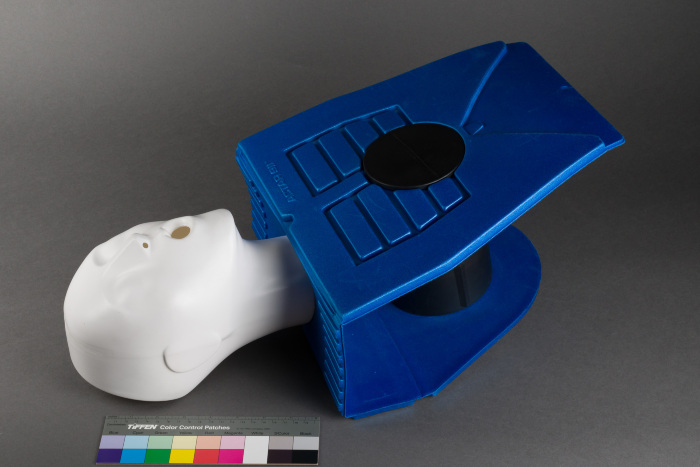 | |
| Examples | Typical Example | The webpage located at URL <https://collections.ssac.carleton.ca/index.php/Detail/objects/2870> incorporates an image of the xDX object 2019.CU.DX.00011 (Teaching Aid Manikin). |
| Example Abstraction | <https://collections.ssac.carleton.ca/index.php/Detail/objects/2870>→ P165 incorporates→ | |